Category: Products
Hotline
Tel: +86 133 1175 6197
WeChat: L13311756197
Email: postmaster@suoqi-cable.com
The mining environment is complex and ever-changing, with high humidity, dust, and high mechanical stress. Therefore, when selecting mining equipment cables, multiple factors must be considered to enhance durability and safety. Below is a sharing of related selection experience 1:
Clarify usage environment and requirements:
Analyze the working environment: It is necessary to assess factors such as the humidity, temperature, and concentration of chemicals in the mine. If the humidity is high, cables with good waterproof performance should be selected; in environments with acids, alkalis, and other chemicals, cables with strong corrosion resistance should be chosen. At the same time, the location where the cable is laid, such as vertical shafts or horizontal tunnels, also needs to be considered, as different locations have different requirements for the cable's mechanical strength and bending performance.
Consider the type of equipment and power supply requirements: According to the power, voltage level, and current of the power supply equipment, determine the rated voltage, cross-sectional area, and conductor material of the cable. For example, high-power equipment requires selecting cables with a larger cross-sectional area to ensure that the cable does not exceed its safe current-carrying capacity when running at full load. In general, copper core cables are recommended for power supply to mining areas and mobile equipment, as they have better conductivity and flexibility.
Choose the appropriate cable type:
Armored cable: Suitable for powering fixed or semi-fixed equipment in mines, especially suitable for vertical shafts or steeply inclined tunnels. According to the horizontal difference of the laying location, appropriate armored materials and structures can be chosen. For example, coarse steel wire armor is suitable for vertical shafts, as it can prevent the cable from sliding due to gravity.
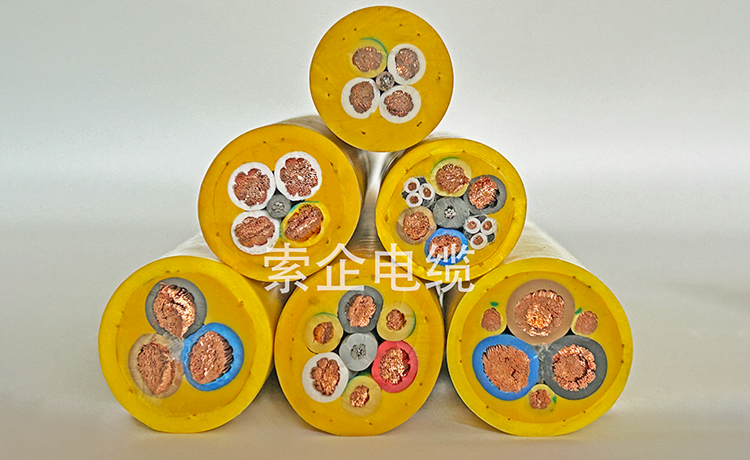
Rubber-sheathed cable: Features flexibility, wear resistance, oil resistance, and acid and alkali resistance, suitable for powering mobile equipment in mines, such as coal miners and tunneling machines.
Plastic cables: Suitable for various mine environments, especially when the cable exterior is armored. Attention should be paid to their insulation performance, temperature resistance, and corrosion resistance. They can be used for underground fixed lines, long-distance power supply, and other scenarios.
Focus on cable performance and quality:
Insulation performance: Ensure that the cable's insulation layer has sufficient insulation strength to effectively prevent leakage and short circuits. For communication signal cables, it is also necessary to select the appropriate type of shielding according to the electromagnetic interference situation, such as using aluminum foil and copper mesh double-shielded cables in strong electromagnetic interference environments.
Flame Retardant Performance: Mining environments are easily flammable and explosive. Cables should have good flame retardant performance and need to be selected from cables that have passed flame retardant tests and meet relevant standards, such as flame retardant class A (IEC 60332-3-24) cables.
Mechanical properties: Consider the cable's tensile strength, wear resistance, and compressive strength. For example, cables with spiral steel strip armor or Kevlar fiber braided layers can be selected, providing better protection under extreme conditions such as mines and tunnels, with compressive strength reaching 15,000N/10cm.
Safety marks: Choose cables issued by the National Safety Mark Center for Mining Products to ensure compliance with relevant safety standards, ensuring quality and safety.
Considering economic and feasibility comprehensively:
Cost-benefit analysis: Under the premise of meeting usage needs and safety requirements, reasonably control cable procurement costs. At the same time, consider cable service life and maintenance costs to select products with high cost-effectiveness. The LCC (Total Lifecycle Cost (LCC) assessment method can be used, comprehensively considering procurement costs, maintenance costs, and fault losses.
Supply Cycle and After-Sales Service: Pay attention to cable supply cycles to ensure timely access to required products without affecting mine production. At the same time, good after-sales service is also important to ensure timely resolution of cable issues if issues arise.
