Category: Products
Hotline
Tel: +86 133 1175 6197
WeChat: L13311756197
Email: postmaster@suoqi-cable.com
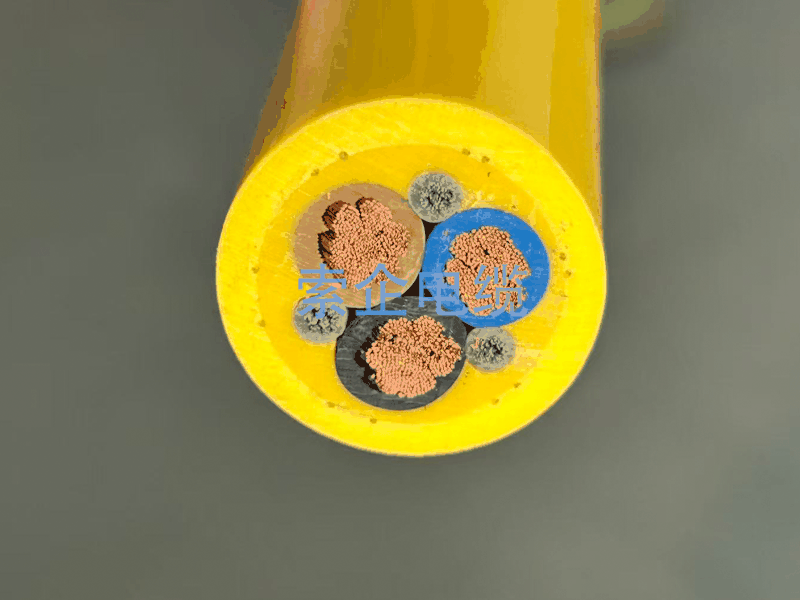
In harsh working conditions such as mining and port loading and unloading, ordinary winding cables frequently encounter issues like sheath cracking, conductor breakage, internal twisting, and bulging, leading to equipment downtime and high replacement costs. To address this pain point, Shanghai Suoqi has made targeted optimizations to its reel cables, from materials to manufacturing processes: the conductor uses multi-stranded ultra-fine oxygen-free bare copper wire (VDE 0295 CLASS 5/6 standard), the sheath is made of imported polyurethane (PUR) compound, and a double-layer sheath with a tensile braided layer strengthens the structure, preventing twisting and bulging. In practical applications, the product has been recognized by customers in wet spraying, mining, and construction fields for its wear resistance, oil resistance, and weather resistance. Insulation: Special TPV compound, insulation thickness 0.6mm - 2mm, insulation temperature range -40℃ to
Product Features
Specifications Conductor: 99.9999% pure annealed oxygen-free copper wire, single wire diameter 0.08mm - 0.15mm, stranded from multiple strands, conductor cross-sectional range 0.75mm² - 16mm², meeting the power requirements of electric wet spray machines of different powers.
Inner sheath: High-strength nitrile elastomer or imported PUR (customizable), thickness 0.8mm - 1.5mm, offering good flexibility and sealing.
Rated voltage: Covers multiple levels such as 0.6/1kV, 1.8/3kV, and can be customized according to the specific voltage requirements of the electric wet spray machine, supporting up to 10kV.
Cable length: Standard lengths are 50 meters or 100 meters, and can be customized to any length according to your needs, with a maximum length of 500 meters.
Tensile strength: ≥1000N, capable of withstanding the high tensile forces generated during the operation of electric wet sprayers.
Application scenarios
Industrial automation, machinery manufacturing, port terminals, and mining operations
Technical Parameters
Parameter item
Technical indicators
Insulation layer
Special TPV composite material with insulation thickness of 0.6mm to 2mm, insulation temperature resistance range of 40°C to 120°C, insulation breakdown strength ≥ 25kV/mm, stable and reliable electrical performance.
Inner Sheath
High-strength nitrile elastomer or imported PUR (customizable), thickness 0.8mm - 1.5mm, with good flexibility and sealing performance.
Outer Sheath
Imported polyurethane PUR composite material, thickness 1.5mm - 4mm, Shore hardness 90A - 98A, excellent wear resistance, long service life.
Minimum bending radius
6-8 times the outer diameter of the cable; during bending, all cable performance parameters remain unaffected.
Operating temperature
-40°C to 90°C, under extreme temperature conditions, the cable's sheath, insulation layer, and conductor can all maintain good performance.
Rated voltage
Covers multiple voltage levels such as 0.6/1kV, 1.8/3kV, etc., and can be customized according to the specific voltage requirements of electric wet spraying machines, supporting up to 10kV.
Cable length
Standard lengths are 50 meters and 100 meters, and any length can be customized according to your needs, up to 500 meters.
Tensile strength
≥1000N, capable of withstanding the large tension generated during electric wet spraying machine operation.
Customized services
Direct sales from Shanghai Suoqi cable factory source, supporting on-demand customization of multiple core counts and specifications. Ample stock available, nationwide shipping. Consultation hotline: 13311756197
Frequently Asked Questions
What is the minimum bending radius of a reel cable?
Generally, it should be no less than 6 times (6D) the outer diameter of the cable. For reel winding and unwinding conditions, it is recommended to check according to the diameter of the equipment drum to avoid long-term bending that could cause the sheath to crack.
Can reel cables and drag chain cables be interchangeable?
No. Reel cables are designed for winding and unwinding, emphasizing torsion resistance and radial compression resistance; drag chain cables are designed for repeated bending, emphasizing bending fatigue resistance. The structural differences between the two are significant.
Related product recommendations
Bending life of metallurgical steel for reel cables
Storage and Logistics Shielding Structure of Reel Cables
Shielding structure of rolled cable for wind power generation
