Category: Products
Hotline
Tel: +86 133 1175 6197
WeChat: L13311756197
Email: postmaster@suoqi-cable.com
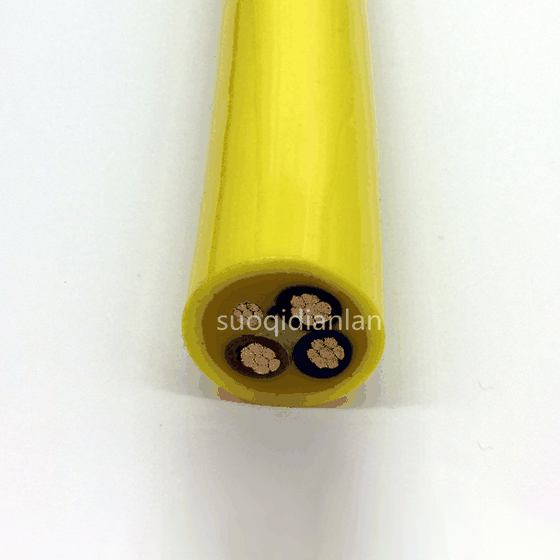
The key to selecting reel cables is to consider the working conditions. Shanghai Suoqi reel cables use conductors made of multi-stranded ultra-fine oxygen-free bare copper wire (VDE 0295 CLASS 5/6 standard). The sheath is made of imported polyurethane (PUR) composite material, with a double-layer sheath reinforced with a tensile braided layer to prevent twisting and bulging. It features high flexibility, tensile resistance, and the core benefits of polyurethane, making it widely suitable for automation, production lines, machinery, and other scenarios. Direct sales from the source manufacturer ensure stable delivery times. Please call 13311756197 to get a selection plan.
Product Features
(2) Stable signal transmission ensures precise production operation Shielding and anti-interference technology: To meet the signal transmission needs of PLC control systems, sensors, servo motors, and other equipment on automated production lines, a double-layer shielding structure is adopted—an inner layer of aluminum foil shielding combined with an outer layer of tin-plated copper wire braided shielding, achieving a shielding coverage rate of up to 99.8%. Whether it is high-frequency electromagnetic interference, static interference, or crosstalk between devices, it effectively isolates data, ensuring the accuracy and stability of data transmission and preventing equipment malfunctions or production errors caused by signal distortion.
Low capacitance and low latency: Optimize cable insulation materials and structural design to control the capacitance per unit length at ≤50nF/km, reduce signal transmission delay by 30%, ensure quick response of control commands and feedback signals in automated production lines, and meet the requirements of high-precision, high-speed production scenarios.
(2) Adaptation for Automated Conveyor Belt Systems Suitable for conveyor belt systems in industries such as food processing and logistics sorting. Facing conditions of 24-hour continuous operation and frequent winding and unwinding of the conveyor belt, the cable outer sheath is made of wear-resistant polyurethane (PU) material, which has oil resistance and chemical corrosion resistance, capable of withstanding erosion from oil, cleaning agents, and the like; the high-flexibility structure ensures that the cable is not easily worn or broken during long-term dynamic use, reducing downtime for maintenance.
(3) Integrated Application of Industrial Robots: Meets the complex motion requirements of industrial robots with multi-axis linkage. The cables can simultaneously transmit power and control signals, supporting precise positioning and collaborative operation of multiple robot joints, ensuring seamless connection of the production process and improving the overall operational efficiency of the automated production line.
Application scenarios
Industrial automation, machinery manufacturing, port terminals, and mining operations
Customized services
As a source manufacturer of special flexible cables, Shanghai cable companies can customize reel cables according to drawings or working conditions, with stable delivery times and controllable quality. Welcome to call 13311756197 for solutions and quotations.
Frequently Asked Questions
Can reel cables and drag chain cables be interchangeable?
No. Reel cables are designed for winding and unwinding, emphasizing torsion resistance and radial compression resistance; drag chain cables are designed for repeated bending, emphasizing bending fatigue resistance. The structural differences between the two are significant.
Why is a Kevlar tensile layer used in reel cables?
During winding and unwinding, the cable is subjected to continuous axial tension. Aramid/Kevlar tensile fibers can share the tension, preventing the conductor from being elongated or deformed and ensuring stable electrical performance.
Related product recommendations
Power Maintenance Sheathing Process for Reel Cables
CNC Processing and Installation Specifications for Reel Cables
Comparison of Construction Parameters of Reel Cables
