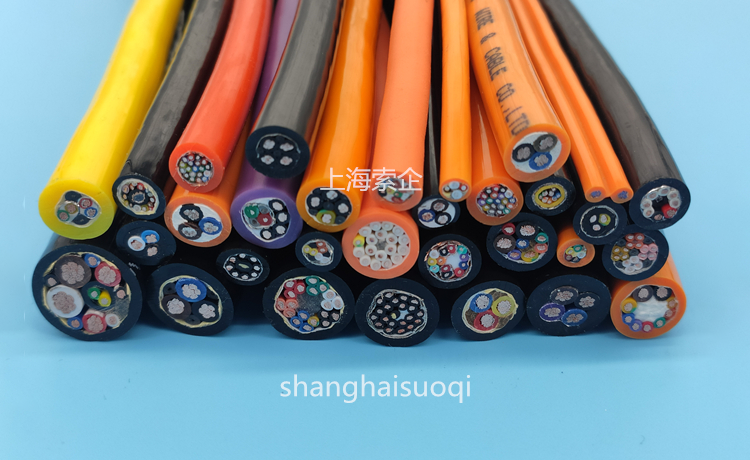
Category: Products
Hotline
Tel: +86 133 1175 6197
WeChat: L13311756197
Email: postmaster@suoqi-cable.com
Shanghai Suoqi's high-flexibility robot drag chain cable – the top choice for flexible industrial transmission
1. Overview of Brands and Products
Shanghai Suoqi Wire & Cable Co., Ltd. has been deeply rooted in the wire and cable industry for many years, building an outstanding brand reputation through cutting-edge technology, advanced production equipment, and a rigorous quality control system. This highly flexible robot drag chain cable is meticulously designed to meet the demanding requirements of industrial robots in complex, high-frequency movement scenarios, serving as a key guarantee for stable equipment operation in industrial automation.
2. Core Product Features
Extremely high flexibility and outstanding bending resistance
Conductor Precision: The conductor uses multi-strand finely twisted oxygen-free copper wire, strictly adhering to VDE 0295 CLASS 6 standard, with an extremely fine single wire diameter. Treated with a unique twisting process, the cable is endowed with extraordinary flexibility. In laboratory tests simulating the actual operation of industrial robots, it can withstand up to 10 million cycles of bending, ensuring structural stability during frequent and complex robot operations, with no core breakage or cracking, guaranteeing long-term stable transmission of power and signals.
Insulation Innovation: The insulation layer uses specially customized hybrid elastomer materials, such as high-performance TPE (thermoplastic elastomer) or specially modified silicone. These materials not only have excellent electrical insulation properties, effectively isolating current and preventing leakage risks, but also significantly enhance the flexibility of the cable, providing reliable protection for the conductor during repeated bending, and maintaining low resistance and signal stability.
Excellent wear resistance and tensile strength
Enhanced wear resistance: The outer sheath is made of high-quality imported polyurethane (PUR) or specially modified PVC, and through special processing techniques, its wear resistance is greatly enhanced. Under frequent friction with robot mechanical components, the wear rate is extremely low, and it can pass over 10 million drag chain wear tests. For example, in welding robot applications in automotive manufacturing workshops, even after long-term friction from high-speed robotic arm movements, the cable outer sheath remains in good condition, ensuring normal cable operation.
Tensile design: The cable is cleverly designed internally, incorporating high-strength central tensile fibers such as aramid yarn fibers, or in special applications with a free suspension length of > 80m, high-strength galvanized soft steel wire ropes are inserted. These tensile components effectively disperse tensile stress, allowing the cable to withstand tensile forces up to 12N/mm². Under the strong pulling forces generated by rapid robot movement and start-stop operations, it will not break or deform, greatly extending service life.
Strong environmental adaptability
Oil and corrosion resistance: Successfully passed ISO 1817 oil resistance tests, the outer sheath has strong resistance to various industrial oil stains, such as lubricants, cutting fluids, and hydraulic oils. In oil-rich industrial environments such as machine tool processing and automotive manufacturing, it effectively resists oil contamination without swelling or brittleness, consistently maintaining good physical and electrical properties to ensure stable operation of cables in harsh oily environments.
Wide temperature adaptation: The operating temperature range is extremely broad; it can stably run within a temperature range of -50°C ~ 90°C during fixed installation, and can adapt to -30°C ~ 90°C during mobile installation. Some specially customized models can withstand short-term temperatures up to 125°C. Whether in scorching steel smelting workshops, cold chain logistics warehouses with low temperatures, or outdoor workplaces with significant seasonal temperature differences, this cable can handle it with ease and operate normally, fully demonstrating its powerful temperature adaptability.
Flame retardant and environmentally friendly: Flame retardant rating meets UL94 V0, strictly complying with IEC 60332-1 fire protection standards. In emergencies such as fires, the cable can quickly and automatically block the spread of fire, buying valuable time for evacuation and firefighting, effectively ensuring the safety of personnel and equipment. Moreover, the production process does not add harmful substances such as lead or cadmium, ensuring safety and pollution, in line with current trends and requirements of green industrial development.
Efficient shielding and anti-interference performance
Single-layer shielding: For general electromagnetic interference environments, the cable is equipped with an anti-oxidation tin-plated copper mesh braided shielding layer with a braiding density of over 85% ≥. This high-density shielding layer can efficiently block various external electromagnetic interference signals, ensuring that internal signals transmitted within the cable are stable and accurate, with no error or delay, effectively preventing equipment failures or abnormal operation caused by signal interference.
Double-layer shielding (optional): In precision robot control scenarios requiring extremely high electromagnetic compatibility, such as high-precision assembly robots in electronic chip manufacturing workshops, a double-layer shielding structure with tin-plated copper wire braided shielding and aluminum foil wrapping can be provided. This double-layer shielding design further enhances anti-interference capability, can withstand more complex and high-intensity electromagnetic interference, ensures zero error in signal transmission, and guarantees the robot's high precision and stability in performing tasks.
Flexible structural design
Core wire arrangement and identification: Core wires can be arranged in a straight line or staggered pattern according to actual usage needs, to accommodate different internal space layouts of robots and electrical connection requirements. The insulation colors of core wires are varied; for wires <0.5mm², colors such as brown, black, blue, red, purple, white, and orange are available. For wires ≥0.5mm², black conductors with white numerical markings are used, making them clear and easy to identify, facilitating installation and maintenance. In addition, cables with more than three cores have a standard yellow/green dual-color grounding wire, further ensuring electrical safety.
Reinforcement and Customization: In addition to the built-in tensile fibers, the cable can also be equipped with high-strength tensile steel wire ropes on both sides according to the customer's special requirements, further enhancing the overall tensile performance to meet the extreme performance demands of the cable under special working conditions. At the same time, the cable structure can be optimized and customized solutions provided according to the customer's specific requirements for cable outer diameter, weight, flexibility, and other characteristics.
Sheath Customization: In addition to common sheath materials such as PUR (black RAL9005, gray RAL7001, orange RAL2003) and specially modified PVC, other high-performance sheath materials can also be customized according to customer requirements for weather resistance, chemical resistance, and other specific needs. For example, UV-resistant sheath materials are suitable for outdoor working robots, and acid- and alkali-resistant sheath materials are suitable for robots in the chemical industry, meeting personalized application scenarios.
3. Key Product Parameters
Rated voltage: When the core cross-sectional area is <0.5mm², the rated voltage is 300/300V; When the core cross-sectional area is ≥0.5mm², the rated voltage is 300/500V.
Test voltage: 2500V, ensuring stable and reliable electrical performance under high-voltage testing, far exceeding industry standard requirements and guaranteeing safety and stability in actual use.
Minimum bending radius: For fixed installation, the minimum bending radius is 5 times the cable's outer diameter; For mobile installation, if the travel < 10 meters, the bending radius is 7 times the cable's outer diameter (7xD); If the travel ≥ 10 meters, the bending radius is 9 times the cable's outer diameter (9xD, where D is the cable's outer diameter). Such a small bending radius allows the cable to better adapt to the complex wiring and frequent bending actions in the robot's confined space.
Insulation resistance: At an ambient temperature of 20°C, the insulation resistance is ≥50MΩ·km, which is much higher than the standard for ordinary cables, ensuring good electrical insulation performance, effectively preventing leakage, and ensuring the safety of equipment and personnel.
Inner sheath: Some models use high-strength composite materials to enhance the internal stability of the cable, protect the core from external damage, and further improve the cable's overall reliability and durability.
Color: The outer sheath comes in various colors, commonly black, gray, orange, etc., and also supports customization of special colors according to customer requirements, making it easy to distinguish and identify in different scenarios, while also meeting customers' requirements for uniform appearance of equipment.
4. Wide range of application scenarios
Industrial robot
Welding Robots: In welding processes in industries such as automobile manufacturing and mechanical processing, welding robots need to operate for long periods in high-temperature and strong electromagnetic interference environments, with frequent and large-scale movements of the robotic arm. The flame-retardant sheath, double-layer shielding design, and excellent flexible resistance of this cable can effectively withstand welding spatter and high temperatures, shield against external electromagnetic interference, ensure stable transmission of power and control signals under complex working conditions, and guarantee welding quality and efficiency.
Assembly robots: Assembly robots used in electronics and 3C product manufacturing require extremely high motion precision, and the cables must have ultra-flexibility and precise signal transmission capabilities. This cable's extremely small bending radius and stable signal transmission performance can accommodate the multi-angle, high-frequency movements of assembly robots in confined spaces, ensuring precise assembly of components and improving product production quality.
Collaborative Robots (Cobot) Collaborative robots often work closely with humans and have strict requirements for cable safety, lightweight design, and anti-twisting characteristics. Some models of this cable feature a flat design with a thickness of only 3–5mm, effectively avoiding the risk of tangling. At the same time, ISO 13849 ensures that even if the cable is accidentally pulled or twisted during human-robot collaboration, it can still protect personnel and equipment and maintain normal operation.
Logistics AGVs and Storage Robots In the logistics and warehousing industry, AGV carts and warehouse robots need to frequently move and start and stop in complex ground environments, making cables vulnerable to ground friction and sudden stop impacts. The outer sheath of this cable is coated with wear-resistant particles and contains a high-strength tensile fiber layer, which effectively handles ground friction and withstands the impact forces generated by frequent emergency stops, ensuring performance does not degrade even after more than 100,000 drag chain movements, guaranteeing efficient and stable logistics operations.
Special scenario robots
Explosion-proof robots: Explosion-proof robots operating in flammable and explosive environments such as chemical and petroleum industries require extremely high safety requirements for cables. This cable uses halogen-free flame-retardant materials. Its ATEX effectively prevents static electricity from causing explosions, ensuring safe and reliable transmission of power and signals in hazardous environments.
Cleanroom robot: In cleanroom scenarios with extremely high environmental cleanliness requirements, such as electronic chip manufacturing and biomedicine, this cable surface features a low-pretit, dustproof design that meets ISO 14644 cleanliness class requirements, preventing particulate contamination during cable use, ensuring the cleanroom environment is not affected, and meeting the demands of high-precision production processes.
Selection Tips
Automated production line environments require high cable UV resistance and aging resistance. This solution features a multi-core combination and is suitable for servo-driven connections. Customization of cross-section, core count, and sheath color is available.
